Sheets with steps Borders by subject
Science Border Design Ideas for Projects, Practicals and Charts
Science border design ideas with beakers, atoms, circuits, DNA, planets and plant stages, each with repeat size, pens, time and drawing notes for A4.
- 8sheets
- 4facts per card: pattern, tools, skill, time
- 23 Novlast checked

With a good science border design, the subject is obvious before anyone reads the title. Beakers, atoms, leaves and planets are simple outlines, so they repeat neatly along an edge and still look like science from across the room.
The eight borders below are grouped from quickest to most detailed. Every card gives the motif, pens, level and time, with notes on how big to draw each shape and how often to repeat it. For a full cover with a title box, see science project front page designs. Other subject borders are on maths border designs and computer border designs.
All 8 sheets at a glance
| No. | Sheet | Skill | Time |
|---|---|---|---|
| 01 | Beaker and flask repeat | Very easy | 20 minutes |
| 02 | Atoms on a dotted line | Easy, class 5 plus | 25 minutes |
| 03 | Circuit line with bulbs | Easy, class 6 plus | 30 minutes |
| 04 | Hexagon chain, test tubes | Medium | 40 minutes |
| 05 | DNA helix, cell corners | Medium, class 8 plus | 45 minutes |
| 06 | Planet rows, star sides | Easy, class 4 plus | 45 minutes |
| 07 | Plant growth stage row | Easy, class 3 plus | 35 minutes |
| 08 | Lab tools chart frame | Medium | 90 minutes |
01Simple Science Border Design
Two quick borders using one motif each. Both fit a practical record or a science notebook page.

Beaker and flask repeat
Black pen, blue and green pens
- SkillVery easy
- Time20 minutes
Beakers and conical flasks take turns along a ruled base line, each with a little coloured liquid. It is the quickest border that clearly says science.
How to draw it: 4 steps
- Draw each glass 1.5 cm tall and leave 1 cm between them.
- Eleven glasses fill a long side; seven fill a short one.
- Fill the bottom third of each with colour: blue, then green.
- Draw a small round bottom flask in each corner to turn neatly.

Atoms on a dotted line
0.3 mm black pen, red pen
- SkillEasy, class 5 plus
- Time25 minutes
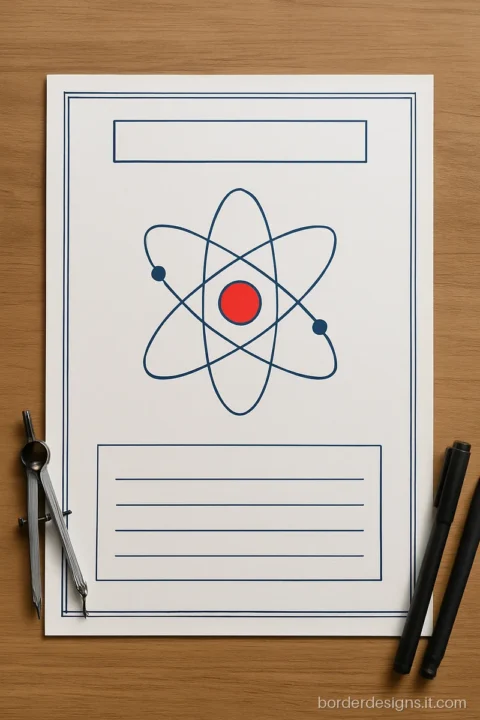
Small atom symbols, three oval orbits and a dot, are linked by a dotted line. Light and neat, it suits physics and chemistry notebooks.
How to draw it: 4 steps
- Draw each atom inside a 1.5 cm circle you mark lightly in pencil.
- Make three thin ovals crossing at the centre, turned evenly.
- Put a red dot in the middle as the nucleus.
- Space atoms 4 cm apart and dot the line between them.
02Border Design for Science Project by Branch
Match the motif to the branch of science. Teachers notice when a chemistry file has a chemistry border.
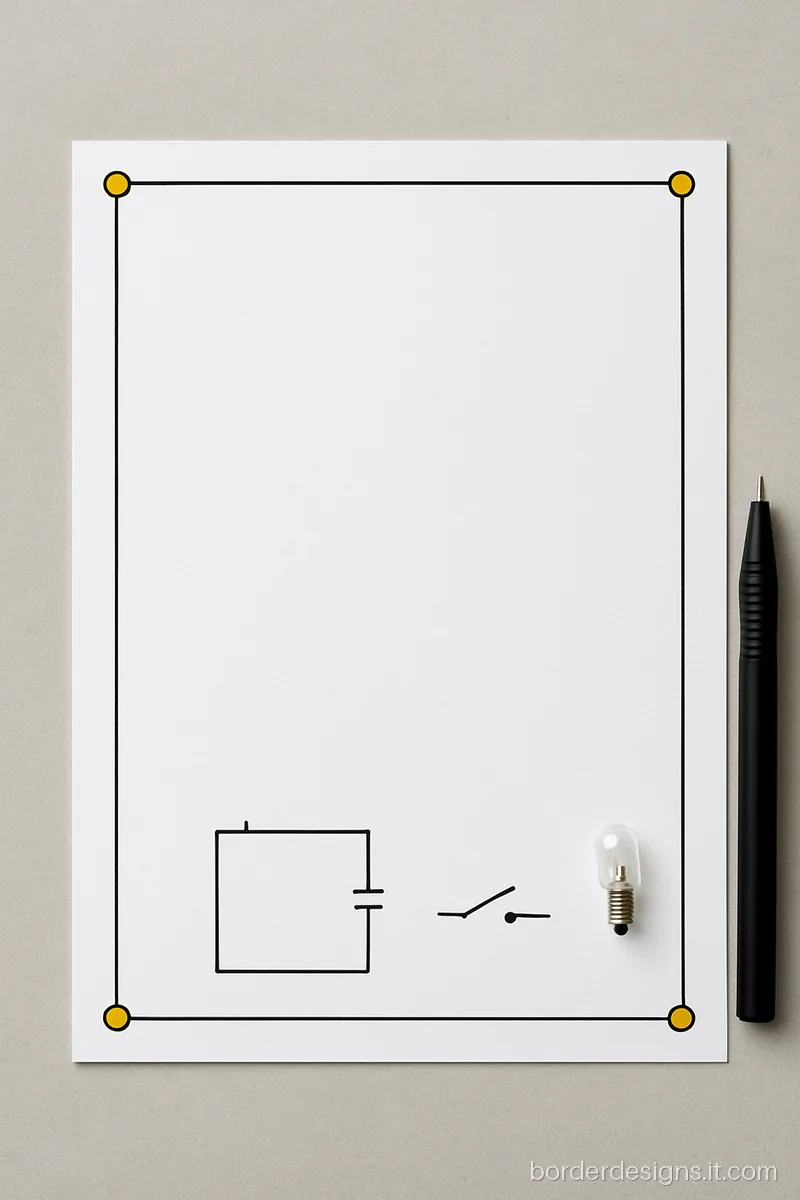
Circuit line with bulbs
Black fineliner, yellow pen
- SkillEasy, class 6 plus
- Time30 minutes
A single circuit line runs round the sheet with a bulb, a cell and a switch on each side. A neat physics border for electricity and energy projects.
How to draw it: 4 steps
- Rule the circuit line 1.5 cm from the edge with square corners.
- Break the line on each side for a small bulb drawn as a circle.
- A cell is a pair of upright strokes, the left tall and the right stubby.
- Colour only the bulbs yellow so they look switched on.

Hexagon chain, test tubes
Hexagon stencil, sketch pens
- SkillMedium
- Time40 minutes
Linked hexagon rings run along the sides with a pair of test tubes in each corner. It looks like a chemistry textbook page and is easy to rule.
How to draw it: 4 steps
- Trace a hexagon 1.5 cm across from a stencil or a cut card.
- Join each hexagon to the next by a short 5 mm line.
- Draw two test tubes leaning together in each corner, 3 cm tall.
- Colour hexagons in two alternating shades of purple.

DNA helix, cell corners
Blue and pink pens, pencil
- SkillMedium, class 8 plus
- Time45 minutes
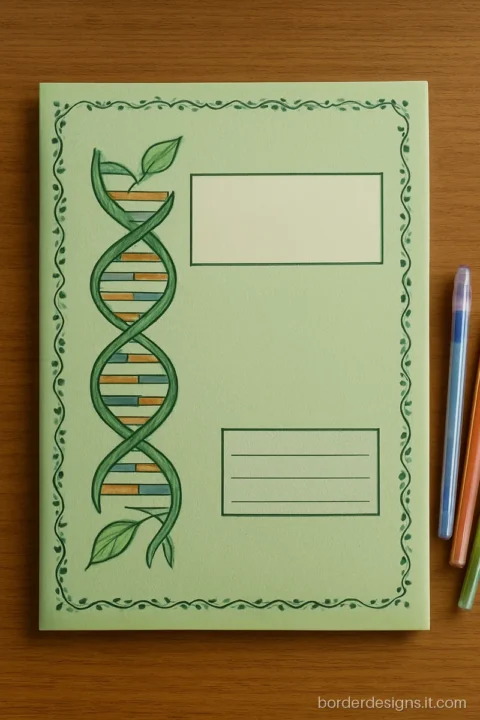
A twisting double helix runs down the left and right edges, with a simple cell drawing in each corner. A strong biology border for genetics or cell topics.
How to draw it: 4 steps
- Sketch two pencil waves twisting over each other every 3 cm.
- Join them with short rungs, 4 to 5 between each twist.
- Colour one strand blue and the other pink, rungs in alternate colours.
- Draw each corner cell 3 cm across with a nucleus and a few dots.
03School Project Science Border Design for Covers and Charts
Bigger motifs and more colour for covers, charts and display sheets in a school project.
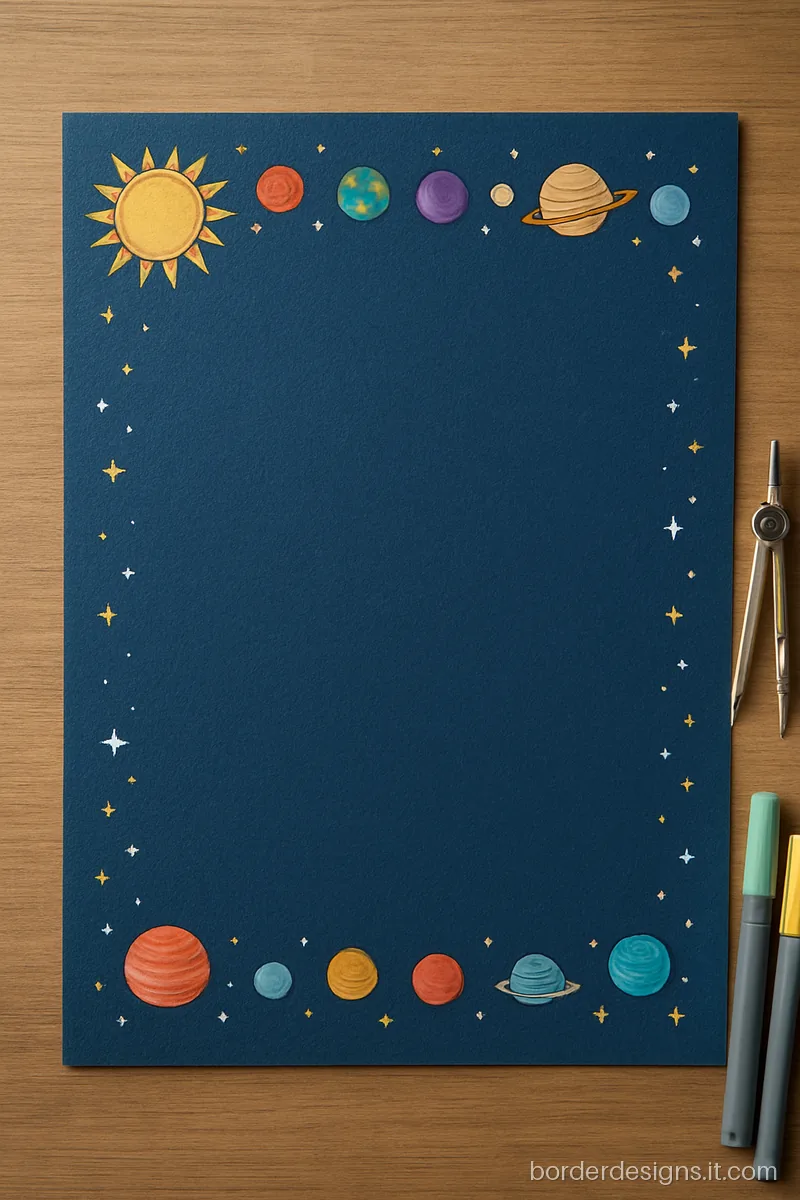
Planet rows, star sides
Sketch pens, compass, black pen
- SkillEasy, class 4 plus
- Time45 minutes
Planets in order of size and colour sit across the top and bottom edges, with stars down the sides. A cheerful border for space, solar system and gravity projects.
How to draw it: 4 steps
- Draw the sun as a half circle in the top left corner, 5 cm across.
- Use a compass for planets between 1 and 3 cm across.
- Give the ringed planet a thin oval ring drawn with a stencil.
- Fill the sides with small stars every 3 cm, not a solid line.
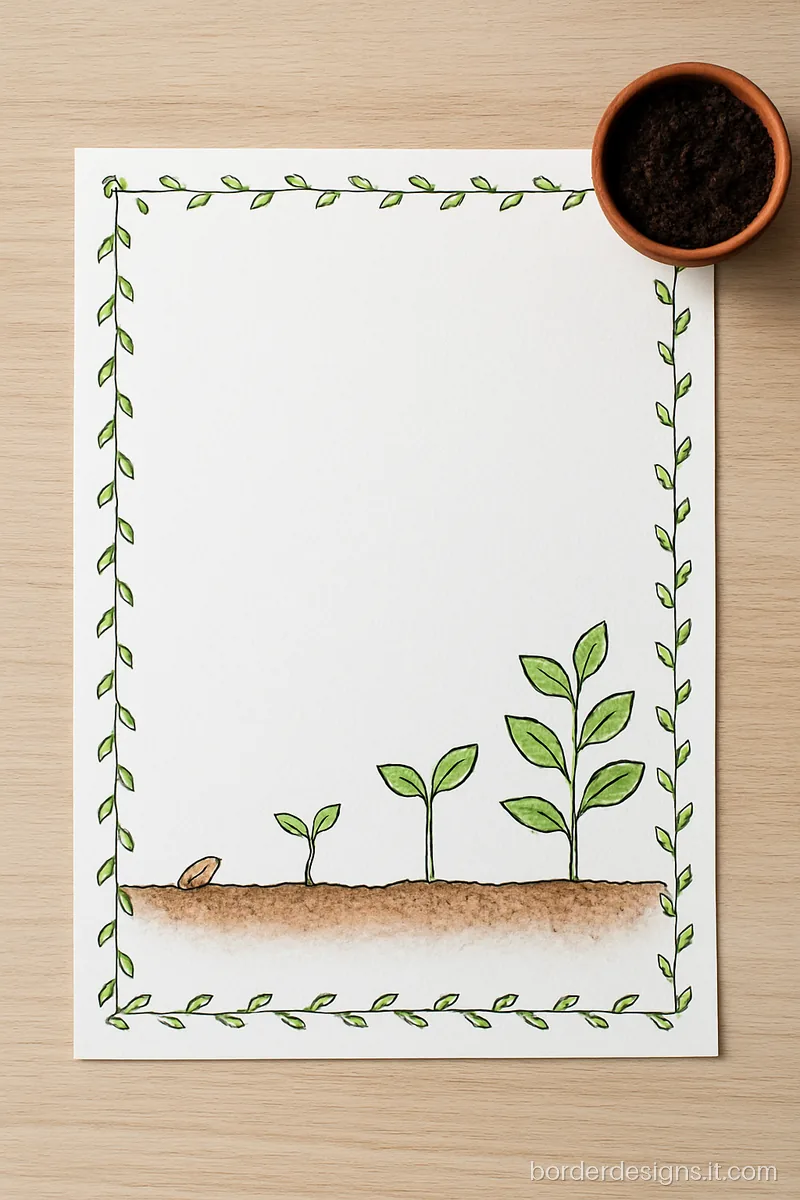
Plant growth stage row
Brown and green sketch pens
- SkillEasy, class 3 plus
- Time35 minutes
A row of pots along the bottom shows a seed, a sprout, a seedling and a small plant, with leaves trailing up the sides. Good for germination and plant life projects.
How to draw it: 4 steps
- Rule a soil line 3 cm above the bottom edge.
- Draw 5 stages, each 3.5 cm apart, getting taller from left to right.
- Repeat the row from the right side so both corners match.
- Run a thin vine of small leaves up both sides and across the top.
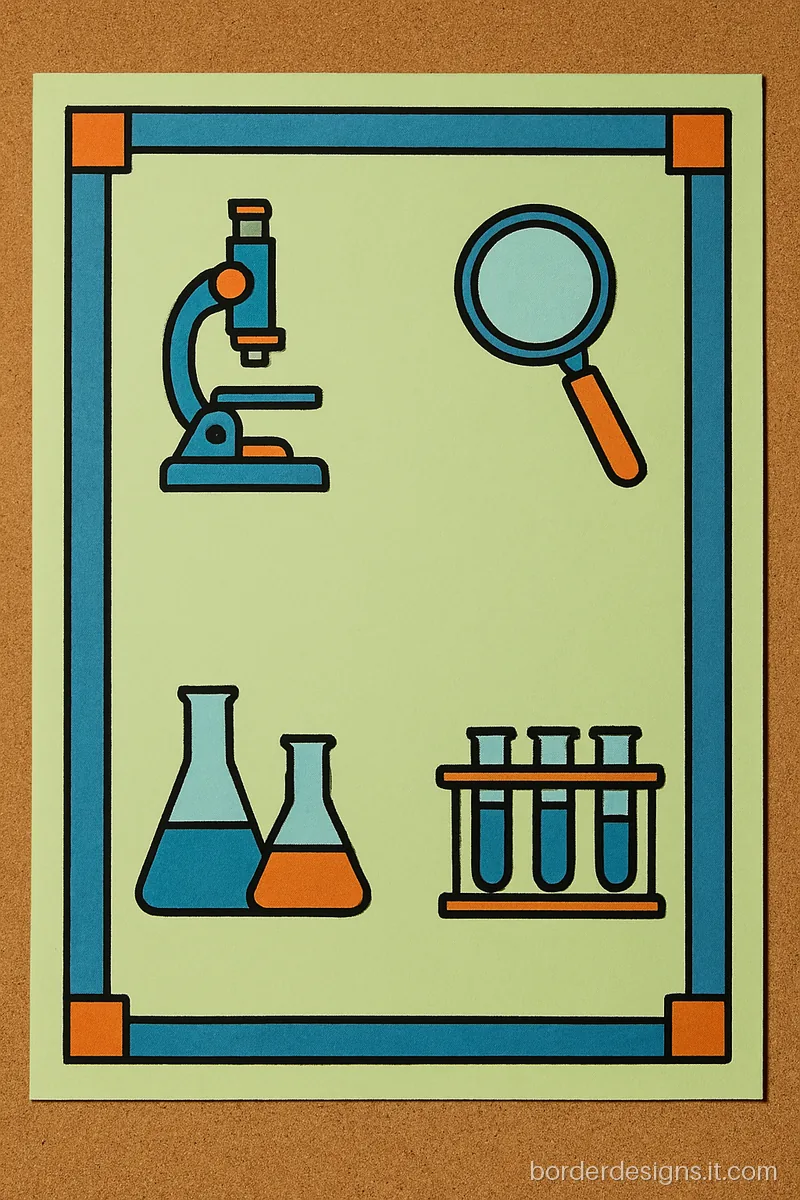
Lab tools chart frame
Chart paper, thick sketch pens
- SkillMedium
- Time90 minutes
Bigger lab tools, a microscope, a magnifying glass, flasks and a test tube stand, sit at even gaps on a 4 cm chart border. Clear from the back of the class.
How to draw it: 4 steps
- Make the border 4 cm wide on chart paper, ruled with a long scale.
- Draw each tool about 6 to 8 cm tall so it reads from far away.
- Put the microscope in the top left, where eyes land first.
- Use thick black outlines and two bright fill colours only.
Science Border Design Motifs by Topic
| Topic | Motifs that work | Size on A4 |
|---|---|---|
| General science | Beakers, flasks, atoms, magnifying glass | 1.5 to 2 cm |
| Physics | Circuit line, bulbs, magnets, gears, waves | 1.5 cm |
| Chemistry | Hexagon rings, test tubes, droppers, bubbles | 1.5 cm |
| Biology | DNA helix, cells, leaves, microscope | 2 to 3 cm |
| Space | Planets, stars, a rocket | 1 to 3 cm |
| Environment | Plants, water drops, sun, recycle loop of leaves | 2 cm |
Pair a single hero shape with a tiny filler like bubbles or dots. Three or more different motifs on one edge start to look cluttered.
How to Draw a Simple Science Border Design Step by Step
- Rule a faint pencil guide around the sheet, 1.2 cm inside the paper edge.
- Draw the corner motif first: a round flask, a large atom or a cell, about 2 cm.
- Divide each side into equal gaps. For 2 cm motifs with 1 cm spaces, you get about 9 on the long side and 6 on the short side.
- Sketch every motif in pencil before inking any of them.
- Outline in black ink, using a ruler for straight flask sides and test tubes.
- Once the ink is dry, rub out the guide and fill in the liquids, bulbs or planets.
For a whole file with a science theme, see science file decoration. A chemistry only cover is on chemistry front page designs.
Mistakes Teachers Notice on Science Borders
| Mistake | Fix |
|---|---|
| Flasks lean in different directions | Rule the base of every glass on the guide line |
| Atom orbits look uneven | Trace one oval from card and rotate it for each orbit |
| Border too busy for diagrams | Use a corner only design or a single circuit line |
| Wrong motif for the branch | Check the topic table above before you start |
| Colour bleeds on thin paper | Use a 120 gsm sheet or colour pencils |
Questions students ask
What is a simple science border design for a project?
A row of small beakers and flasks along a ruled line, each partly filled with colour. It takes about 20 minutes with a black pen and two coloured pens.
Which border design suits a biology project?
A DNA helix down the sides, cells in the corners or a leafy vine. Keep the motifs 2 to 3 cm so there is room for diagrams inside.
What border is good for a physics project?
A circuit line with small bulbs and cells, or a row of magnets and waves. These are mostly straight lines, so a ruler keeps them neat.
How many motifs fit on an A4 science border?
With 2 cm motifs and 1 cm gaps, about 9 fit on the long side and 6 on the short side, plus one in each corner.
Can I use the same science border on every page of my file?
Yes, and it looks neat. Use the full border on the cover and dividers, and a lighter corner or line version on pages with lots of writing.